Five Days in Alsace
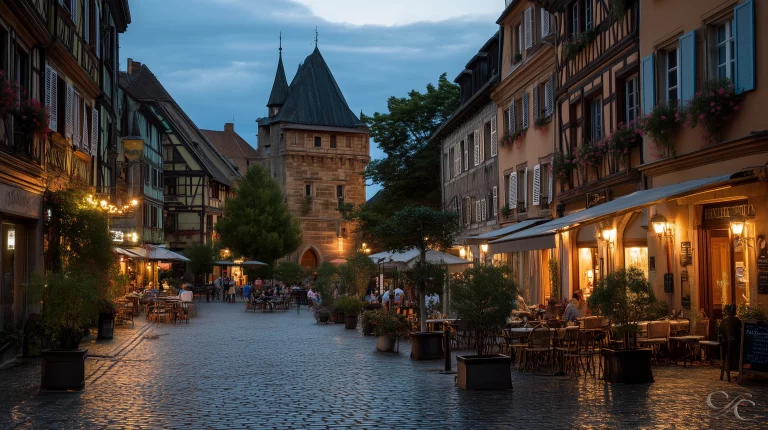
Leaving the vineyards and winding river valleys of the Mosel behind, I continued south into the Alsace, where another distinctive wine region awaited. Strasbourg was the starting point for my five-day November journey through Alsace, following the eastern foothills of the Vosges toward Eguisheim. This corridor forms the heart of the Alsace Wine Route, inaugurated in 1953 and now extending roughly 170 kilometres through vineyards and historic wine villages.
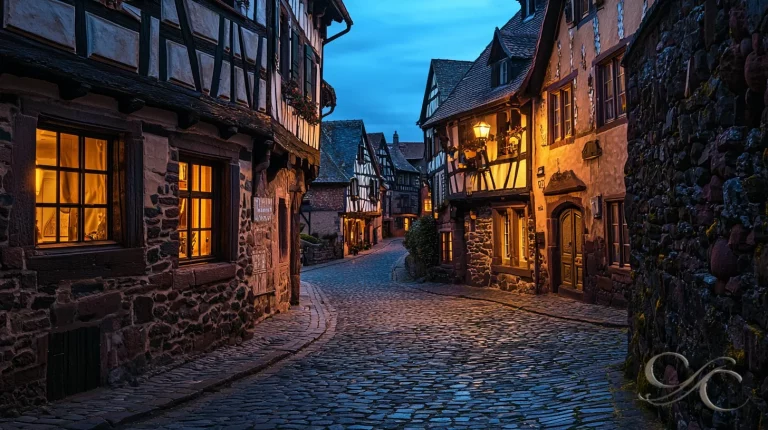
The mountains shelter the plain from much of the rain arriving from the west, helping to make Alsace one of France’s driest wine regions. Its cultural geography reflects a more complex history. Alsace was annexed by the German Empire in 1871 and returned to France in 1918, one chapter in a longer period of shifting borders. French and Germanic influences remained visible in timber-framed houses, local place names, food and everyday speech. I kept my plans loose enough for cellars, bakeries, museums and unplanned conversations along the way.
First Steps in Strasbourg
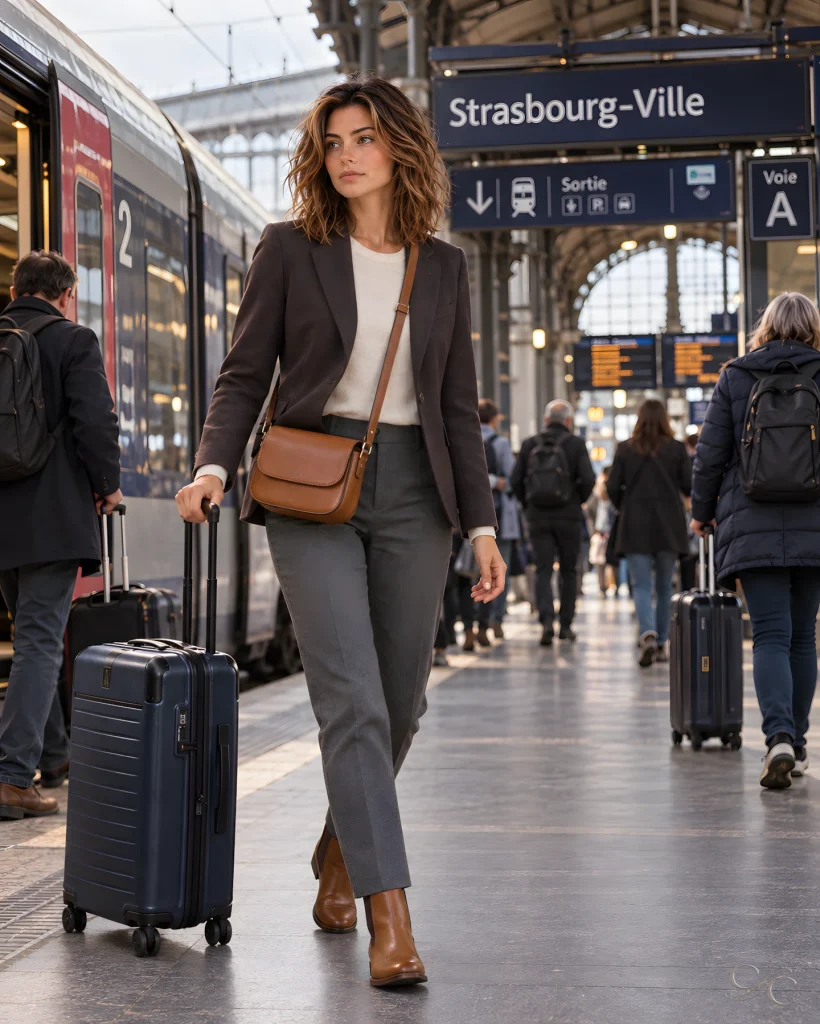
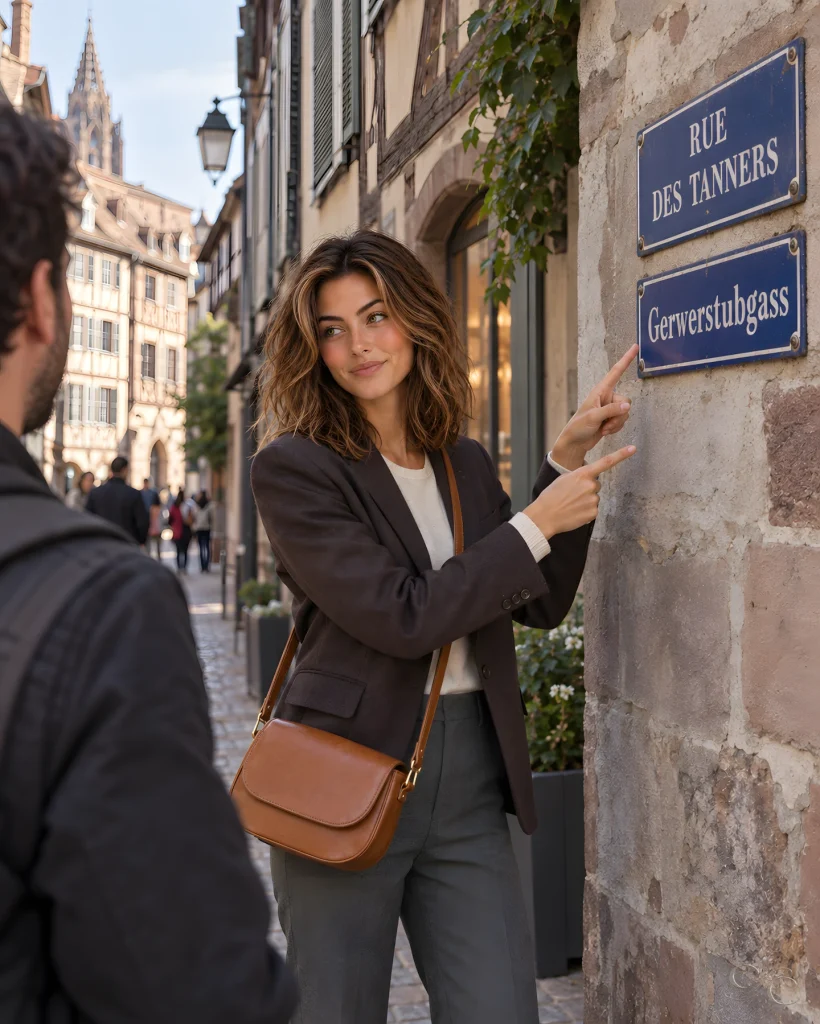
From Strasbourg-Ville, I rolled my suitcase through the concourse and headed toward the historic centre. On a narrow street, two plaques gave the same name in French and Alsatian. I pointed between them and tried to sound out the Alsatian version; one of the camera crew repeated the pronunciation after me.
Alsatian is an umbrella term for Alemannic and Franconian Germanic dialects; the traditional Strasbourg variety is Low Alemannic. The paired signs placed the regional language beside the French used throughout the city.
Making Room at the Café
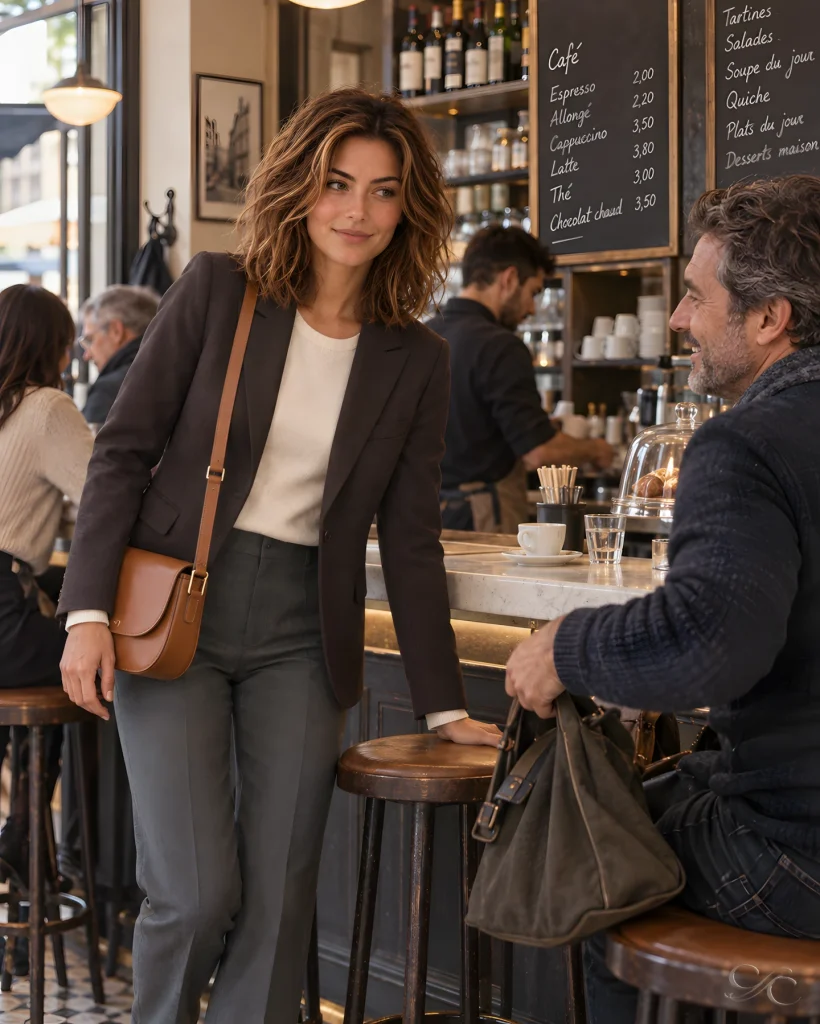
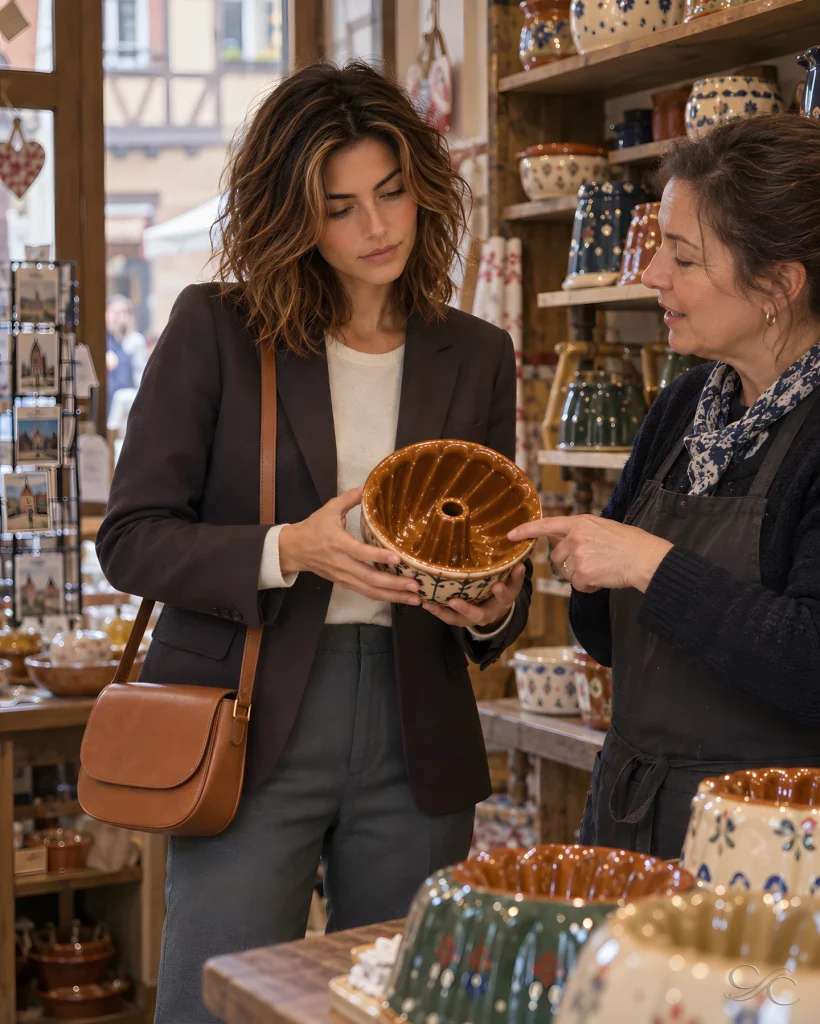
At a compact café counter, a neighbouring patron lifted a bag from the only free stool and gestured me into the space as my coffee arrived. Nearby, shelves of patterned ceramics held traditional Kougelhopf molds.
I turned one in my hands while the shopkeeper pointed out its deep fluting and central chimney. The mold gives the Alsatian yeast cake its tall, ridged ring and helps the rich dough bake evenly. I returned it to the shelf and settled onto the stool that had been cleared for me.
Finding Space for Tarte Flambée
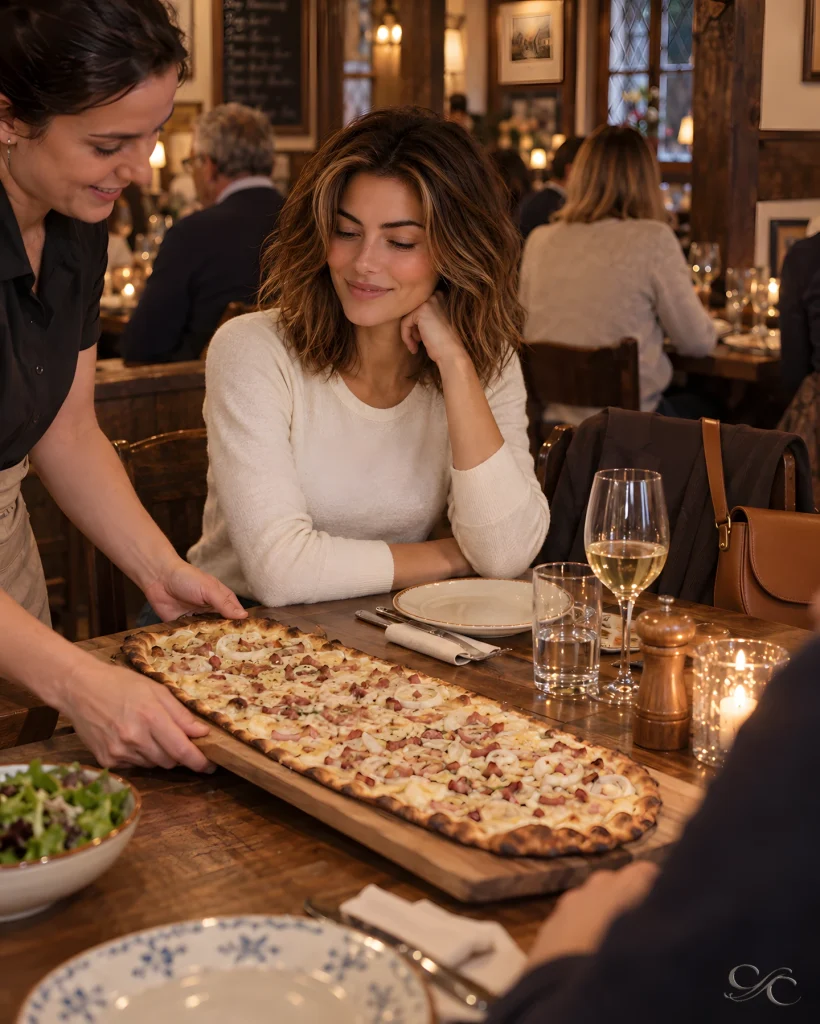
The server and I shifted the carafe and small plates until a long board of tarte flambée fitted between us. Around the close-set wooden tables, nearby diners continued their meals without ceremony.
Also called flammekueche in Alsace, the dish begins with dough rolled very thin, traditionally topped with cream, onions and lardons, then baked at high heat. The board occupied most of my table. The carafe, cutlery and remaining plates stayed at the edges until I had worked my way through the tarte.
The Regional Train to Obernai

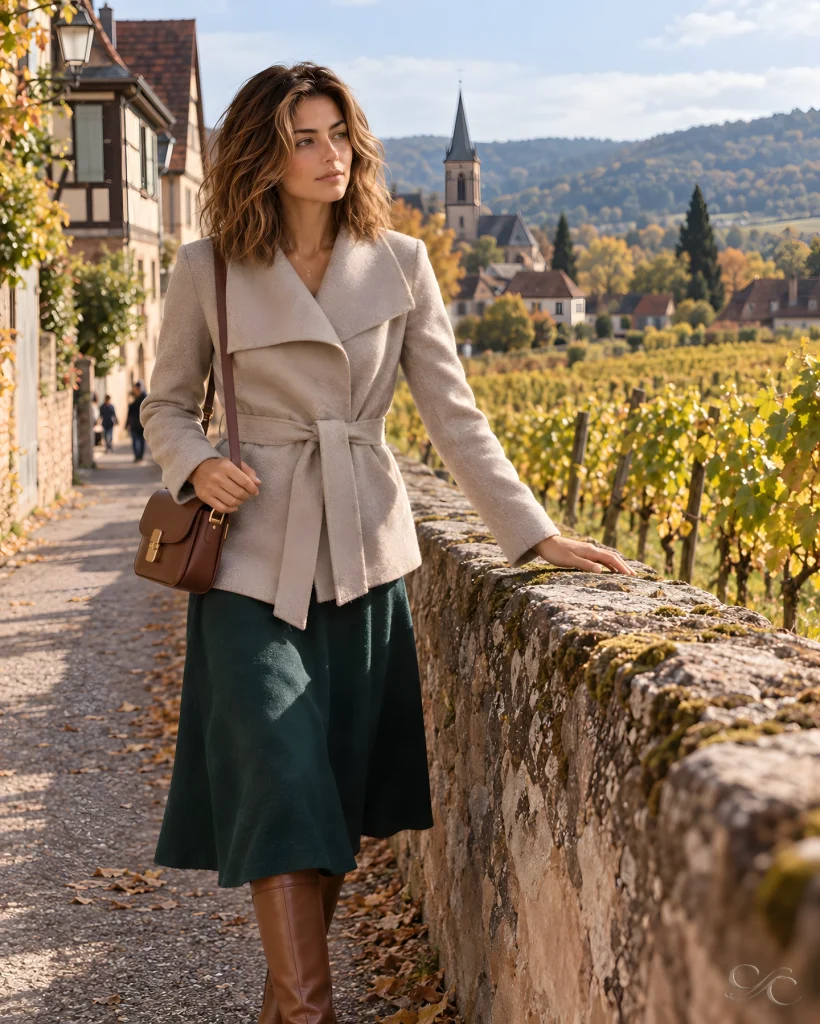
As the regional train cleared Strasbourg’s outskirts, buildings thinned into open fields and villages beneath the Vosges foothills. When we slowed, a nearby passenger confirmed that we had reached Obernai and pointed through the window toward the first vineyard slopes.
I followed the residential lanes outward until the half-timbered houses receded behind low walls. At the end of the last lane, I stepped onto a public vineyard path, my hand brushing the wall beside orderly rows climbing toward the foothills.
A Local’s Window-Seat Lesson
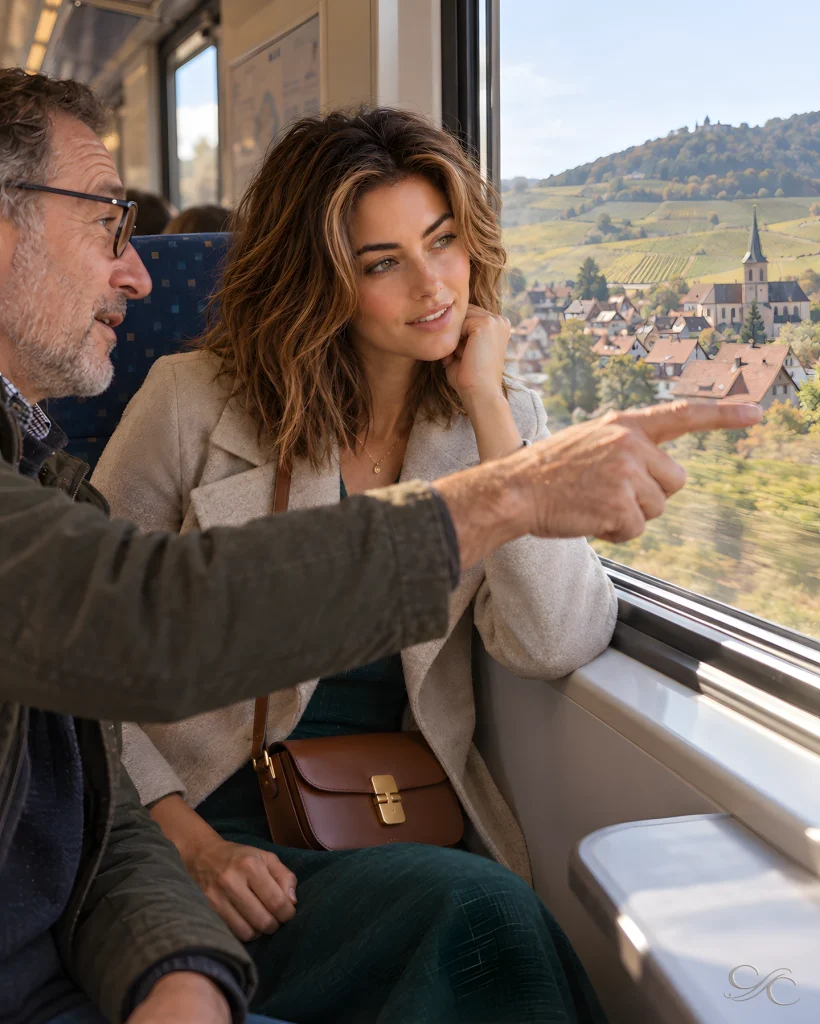
On the short ride south to Barr, a fellow passenger traced the lower slopes with a finger. Beyond the glass, fields gave way to village roofs, with vineyard rows rising behind them. Barr, the passenger explained, was the settlement tucked beneath those vines.
I followed the gesture instead of opening my map. Open fields lined the railway; farther ahead stood tiled village roofs, and behind them rose the vineyard-covered foothills of the Vosges.
Harvest Crates Put Away
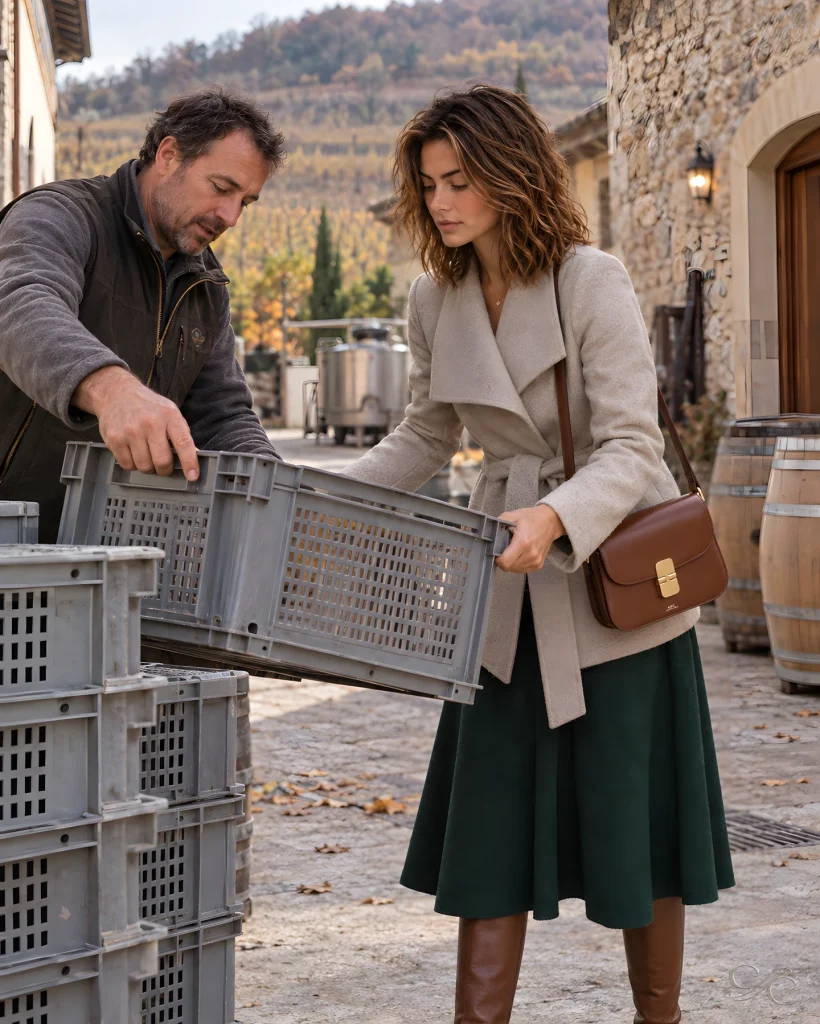
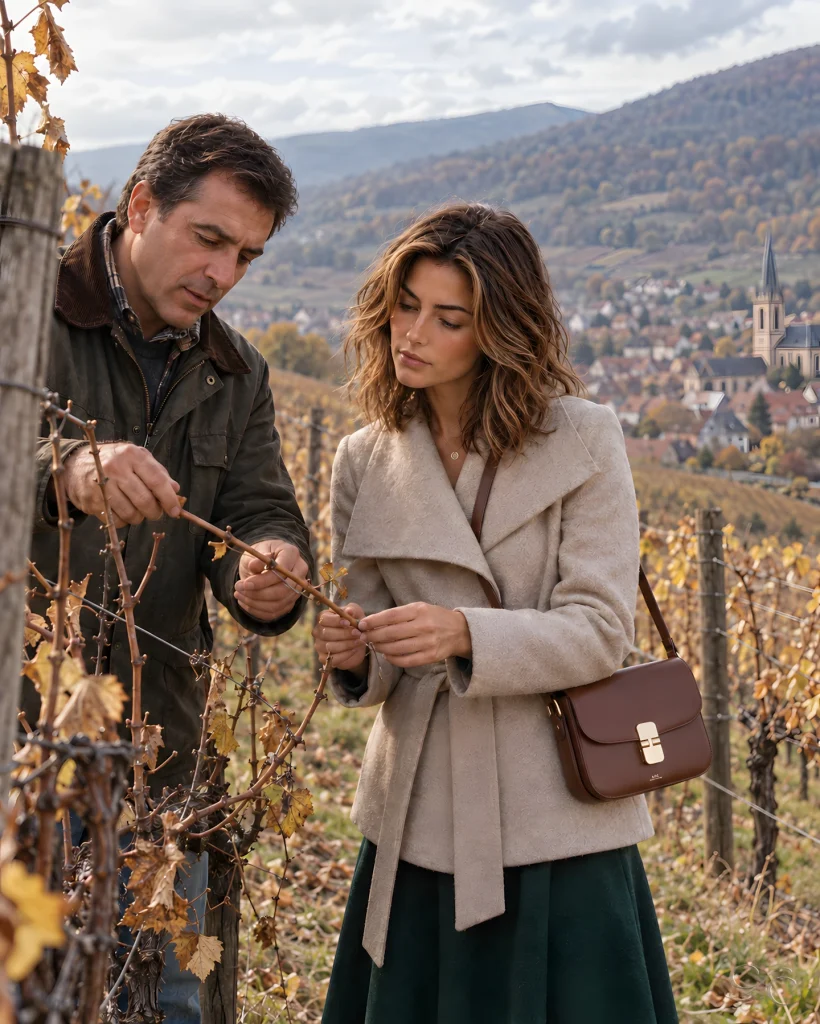
In a winery courtyard, the winegrower rotated an empty harvest crate to show me how its corners interlocked. I fitted it onto the stack stored for winter, clearing away one remnant of the finished harvest.
Among the rows, he placed a retained cane in my hands and bent it gently while I followed the movement. In cane-pruned vineyards, selected one-year-old wood carries the buds for the next season’s shoots. Its condition and flexibility matter when it is bent and tied to a support wire. The harvest crates had been put away, but work among the vines continued.
The Old Press Resists
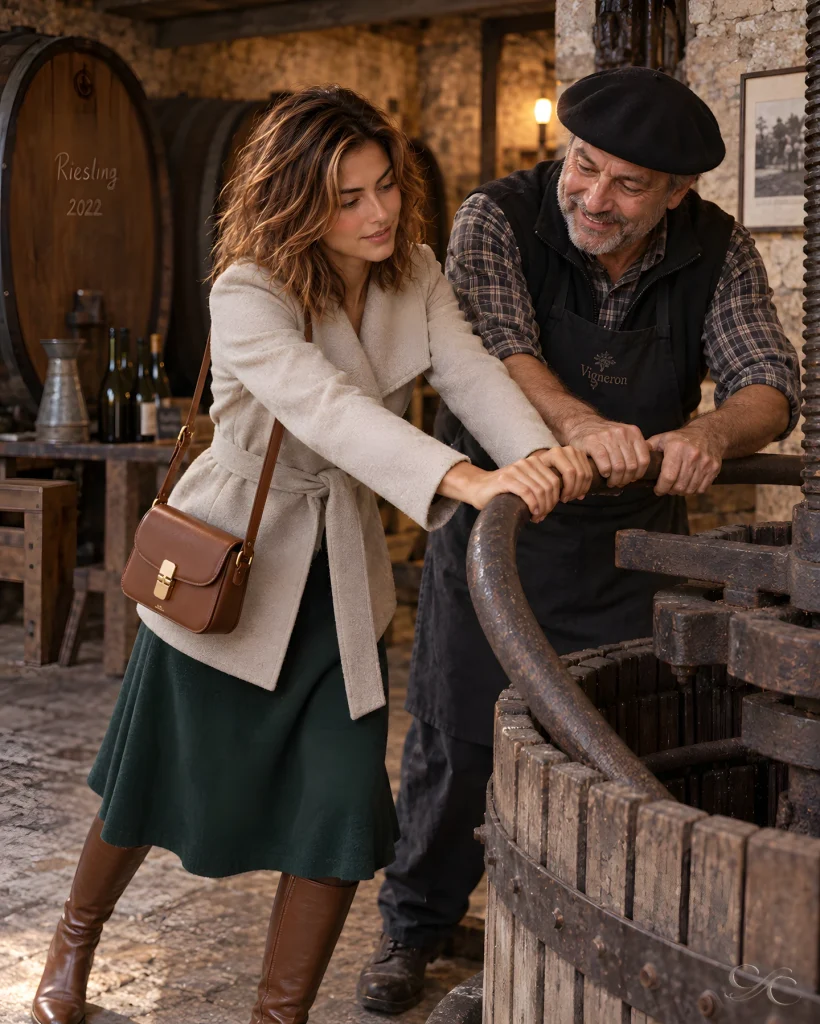
Inside the stone cellar, I set both hands against the old press wheel and pushed. It barely shifted. The winegrower placed a hand beside mine, and together we managed a small turn.
On presses of this kind, the wheel drove a screw downward, using leverage to squeeze grapes or pomace. A larger wheel or longer handle can increase the torque applied to the screw; overall mechanism size alone does not necessarily increase force. Moving it those few centimetres took both our weight.
Passing Through the Butchers’ Tower

Ribeauvillé’s main street tightened beneath the Tour des Bouchers, the medieval gate tower named for the butchery activity established in the houses at its foot. I pressed against the stone while a resident guided a bicycle through, and we resolved the right of way with a quick smile.
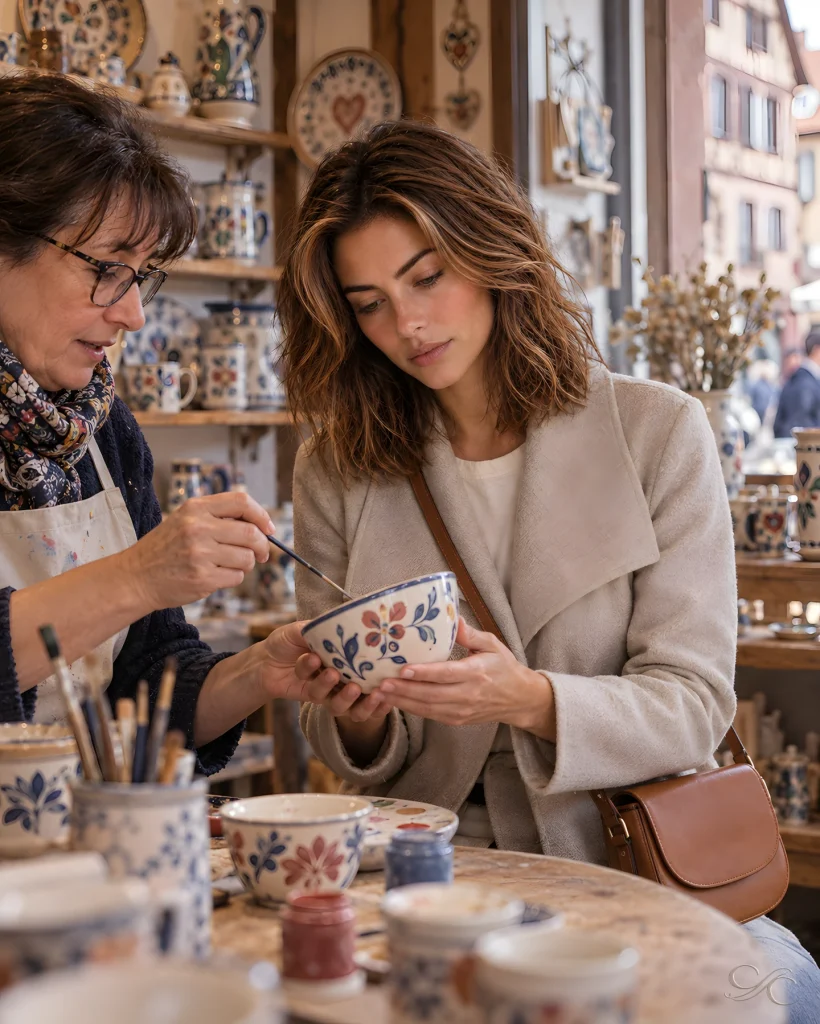
Beyond the arch, an artisan’s small workshop brought another close negotiation. I steadied a ceramic piece as the artisan painted the final detail, then followed a guiding hand away from the wet surface. The motif had been built from small, repeated strokes, each placed close to the next.
The Narrow-Street Delivery


On my first walk through Riquewihr, I had to make way for a wine delivery. I turned sideways into a shallow doorway while a worker edged his loaded handcart past. When one loose crate threatened to scrape the wall, I lifted its corner and he steered the load through.
Later, a shopkeeper helped me read the street overhead. The shopkeeper traced a small trade symbol on a projecting metal sign, then pointed back to the corresponding business. Before standardised street numbering, such emblems identified a trade or premises to passersby. Without the gesture, I might have walked beneath it without looking up.
Holding the Trellis Steady
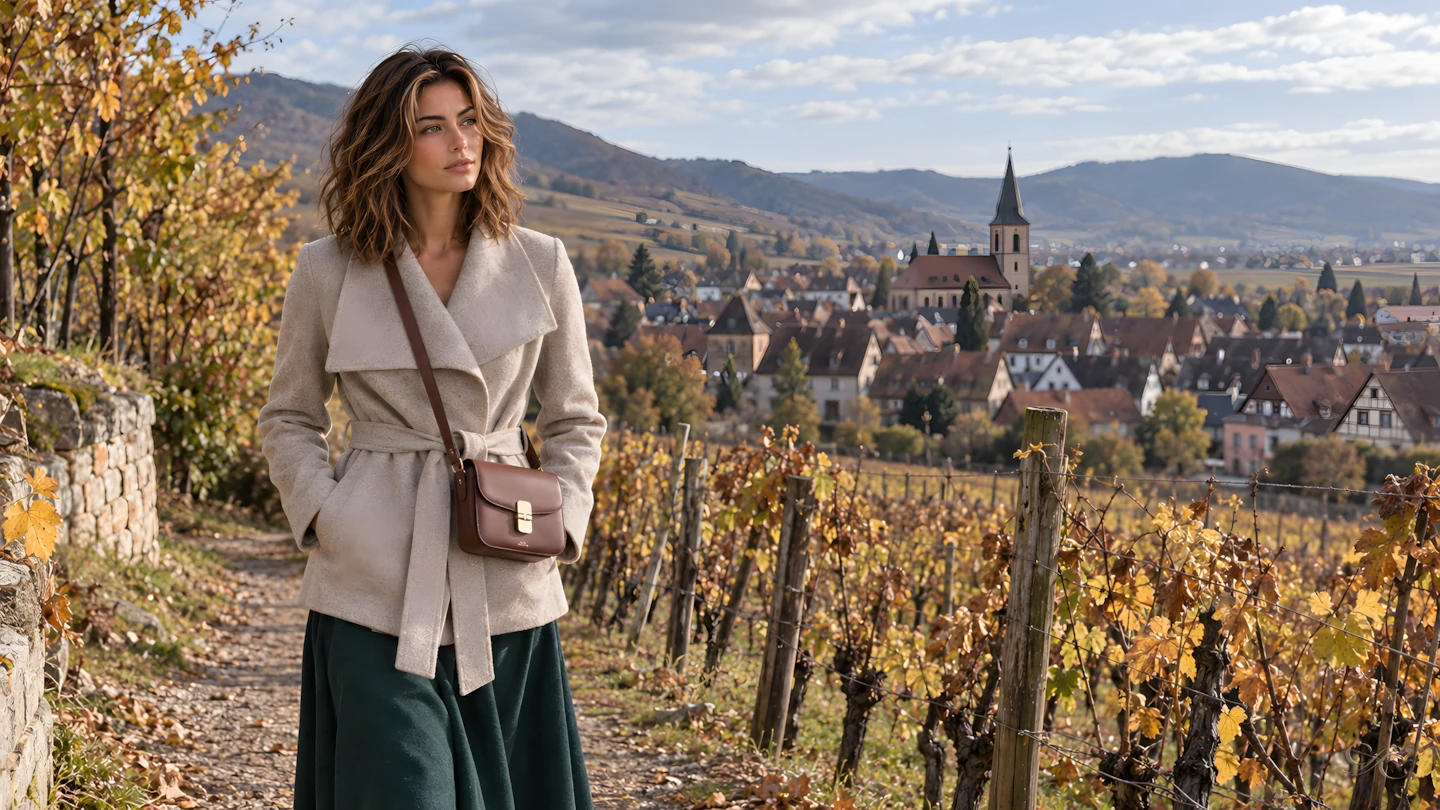
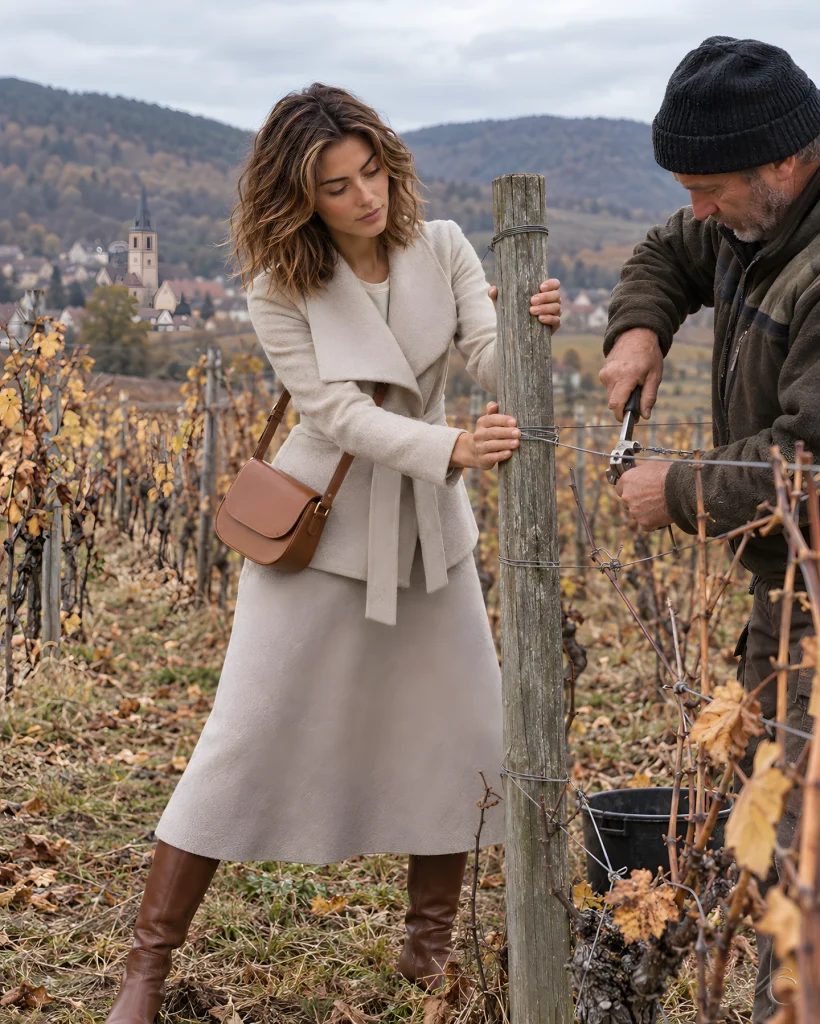
Beyond the village, I braced an end post with both hands while a grower tightened a loosened wire. The rows had thinned to exposed canes and fading ochre leaves beneath the November sky.
An end post takes the combined pull of the trellis wires, which support and position the season’s growth. If the post shifts, tension can slacken along the row. The grower signalled when the wire was taut enough, and I released my grip.
One More Layer for the Munster
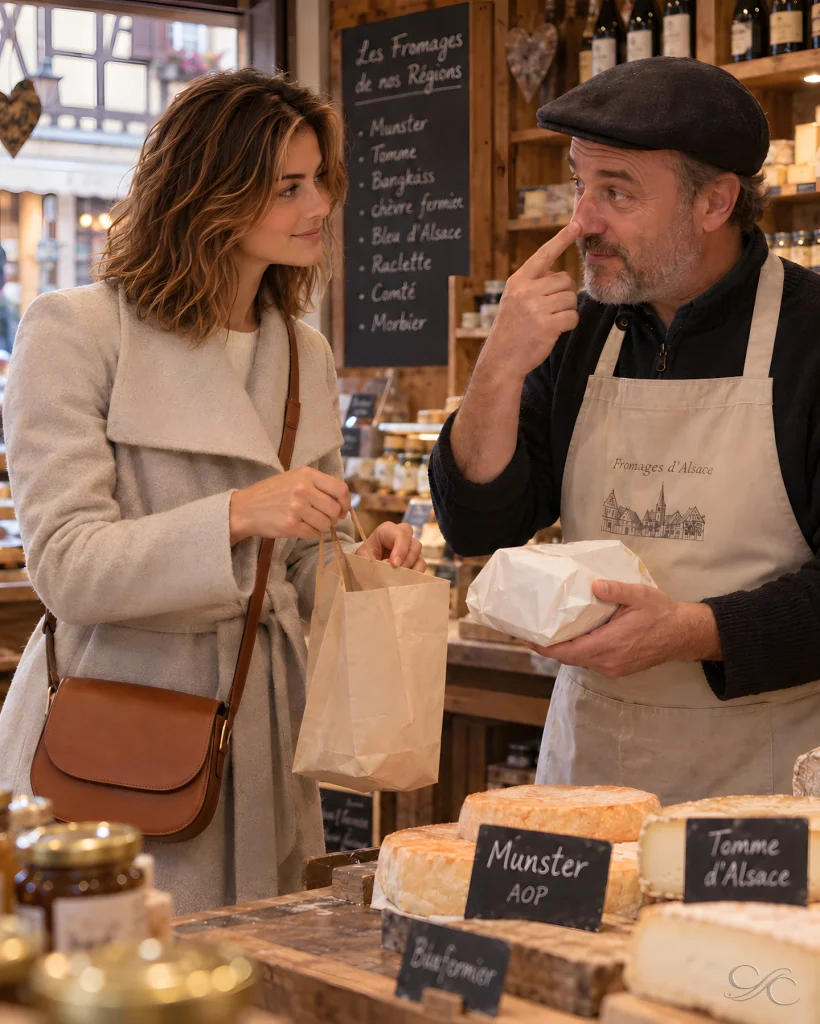
I chose a small piece of Munster, whose pungent aroma comes from its washed rind. The cheesemonger had already wrapped it once, then reached for another sheet of paper before placing it in my shopping bag.
He tapped his nose by way of explanation. I tightened the drawstring in reply. Two layers and a firmly closed bag seemed sensible for the journey onward.
Ducking with the Canal Boat
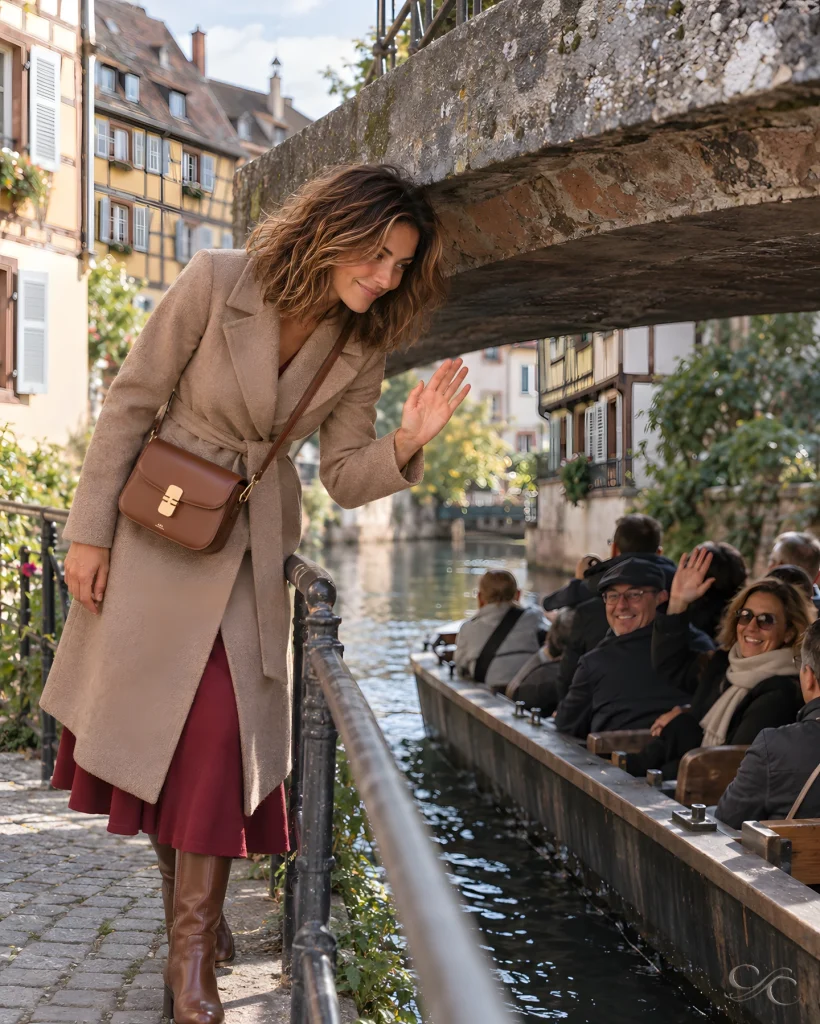
At Petite Venise in Colmar, the Lauch narrowed between close-set half-timbered houses and passed beneath an old low bridge. As a canal boat approached, its passengers lowered their heads.
I ducked with them from the bank, an entirely unnecessary act of solidarity. Once they had cleared the bridge, I raised a hand. They straightened and waved back.
Reading the Isenheim Altarpiece
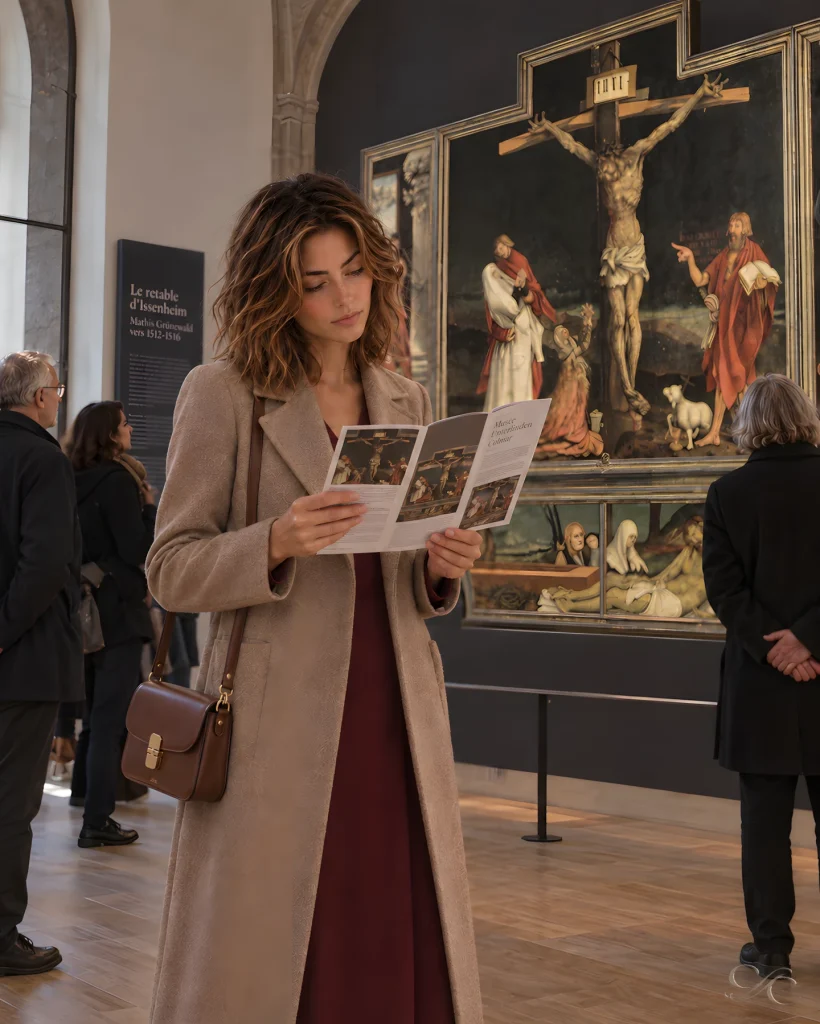
At the Unterlinden Museum, I moved along the open panels of the Isenheim Altarpiece, matching a detail in the leaflet to the original. Made around 1512–1516 for the Antonite monastery at Isenheim, the altarpiece’s Crucifixion was seen by patients in the order’s hospital. Its hinged construction allowed different scenes to be displayed.
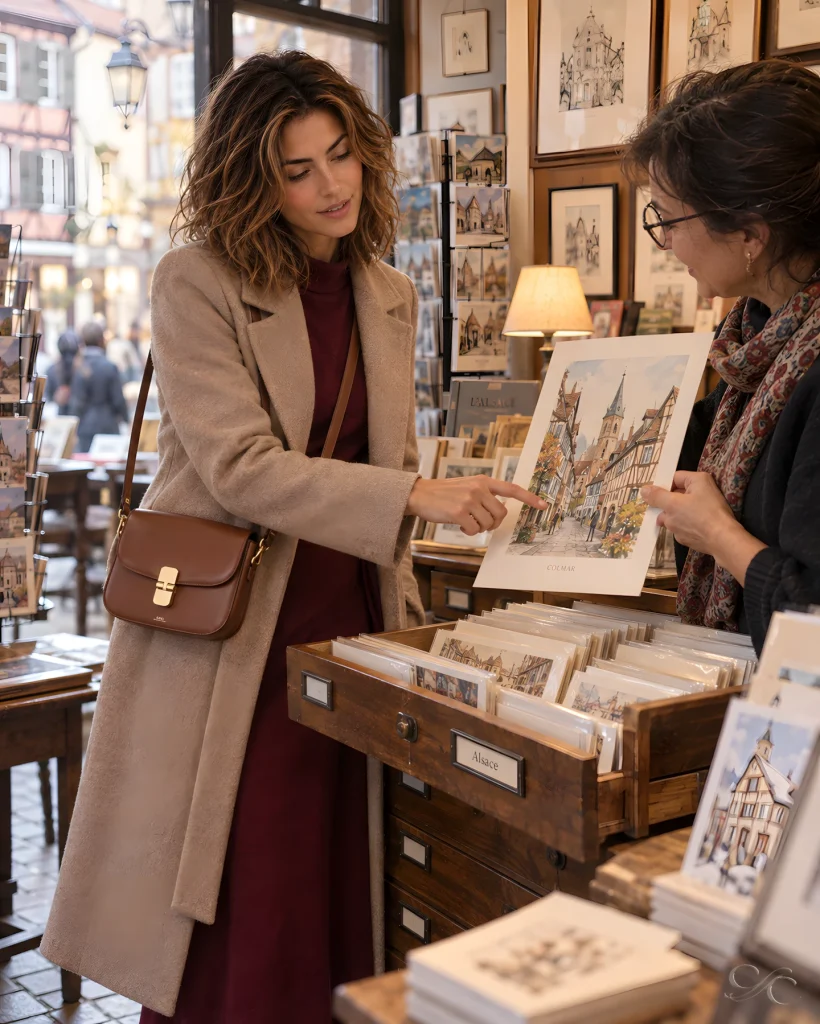
Later, in a small print shop, the shopkeeper lifted an illustrated Colmar street from a drawer. I pointed out a half-timbered facade I recognised—not a landmark, but one I had passed earlier that day.
Dinner with the Crew
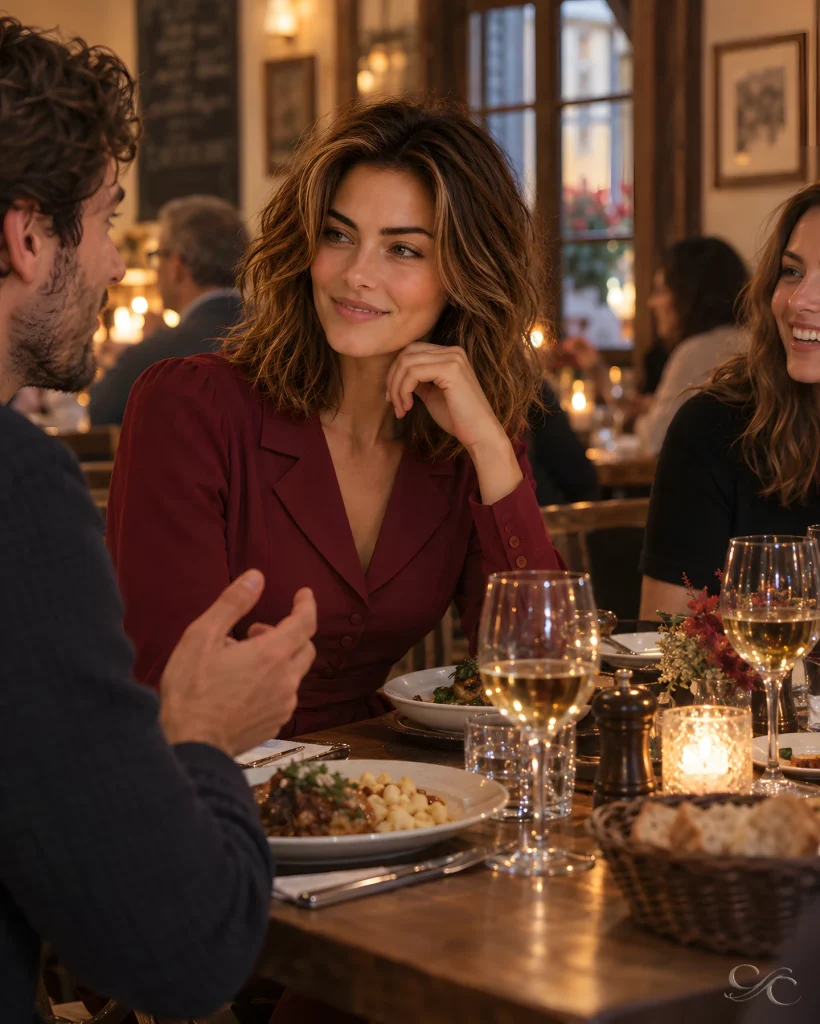
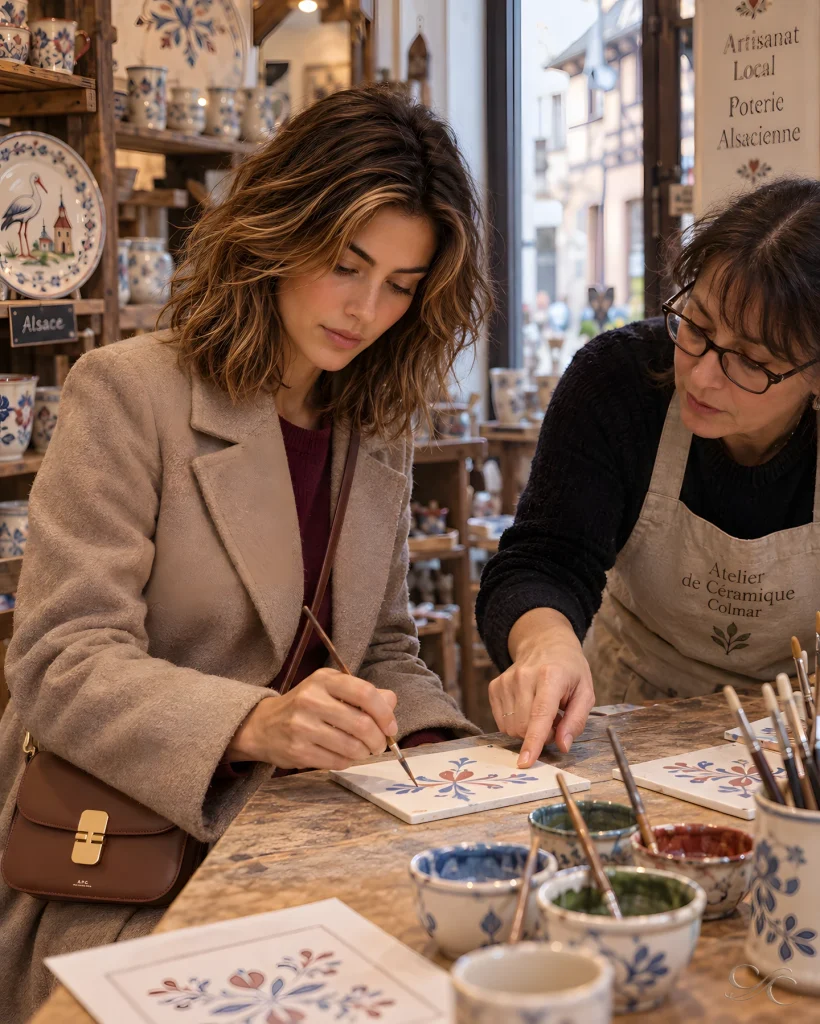
Over dinner in Colmar, we returned to fragments of the day, including my single contribution to an Alsatian practice tile. The ceramic decorator had guided me by pointing to the next place in the repeating motif rather than taking the brush. The pattern depended on small, controlled marks; mine had required conspicuous supervision.
The camera crew had noticed. Between regional dishes and glasses of Alsatian wine, the account became gentle teasing and then laughter, the shorthand of companions several days into a journey.
The Mold with a Past
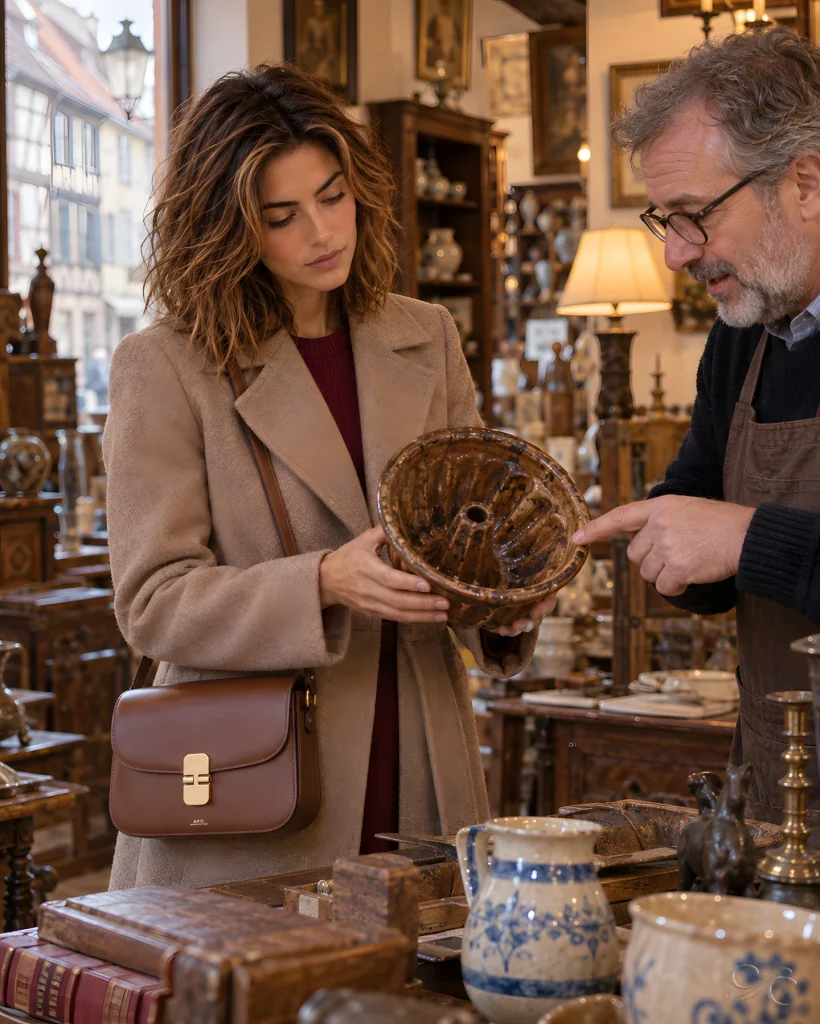
I took the glazed earthenware piece for a decorative bowl until the antique dealer turned it over and identified it as a Kougelhopf mold. Along the deep flutes, the glaze had worn thin. Darker patches marked the places repeatedly exposed to heat and rich dough.
She set it upright and traced the ridges that had shaped generations of cakes. Despite its decoration, it had not spent its life on a shelf. Years of use in an Alsatian kitchen remained visible in the baking marks.
From Vines to Village
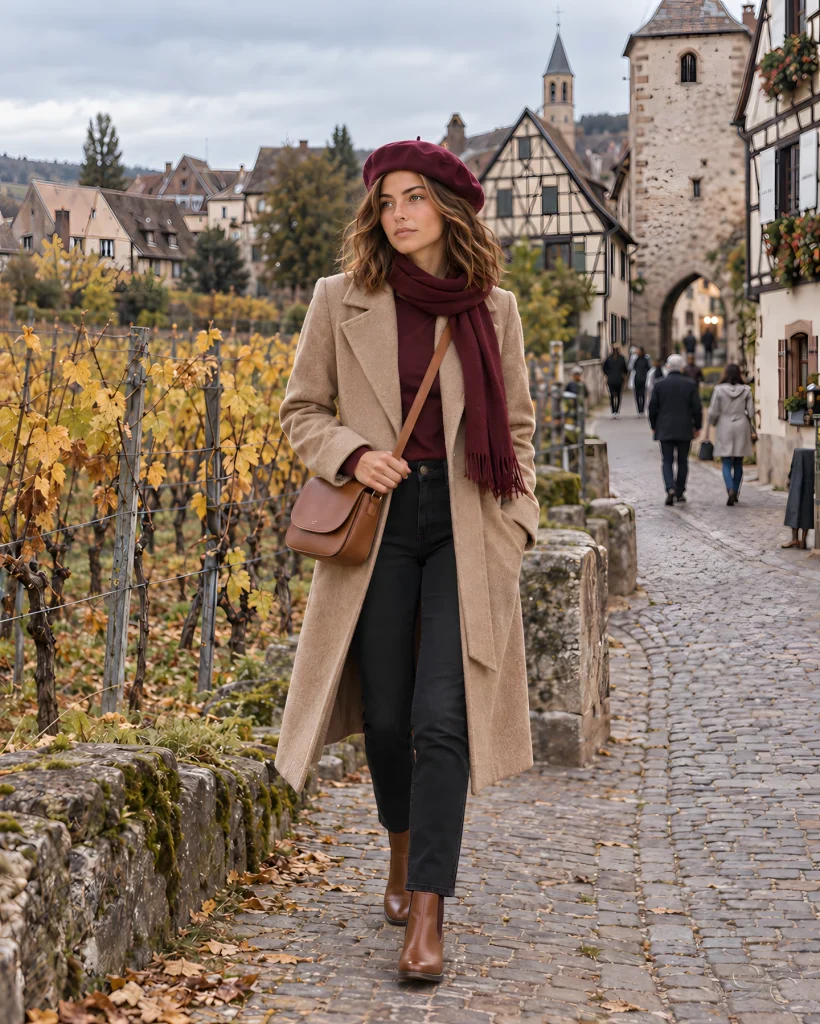
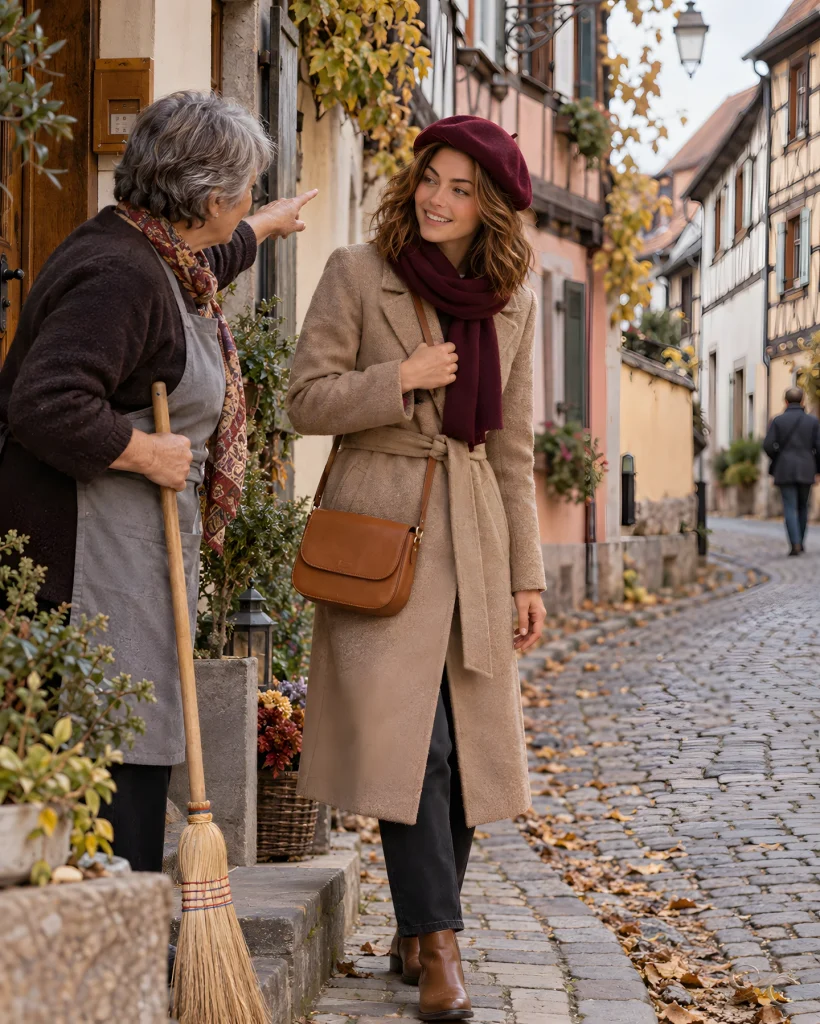
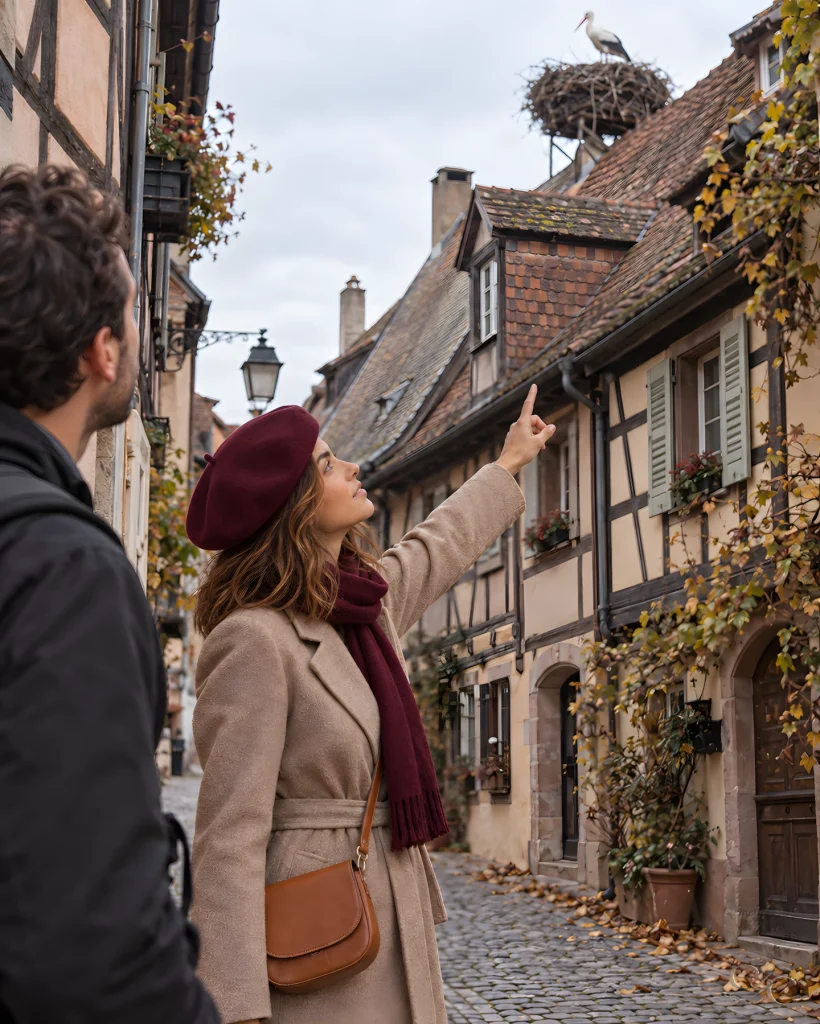
Fading ochre vineyard rows ended at Eguisheim’s compact edge. I tightened my scarf as the first houses blocked the wind and followed a lane curving along the old rampart.
Eguisheim’s streets form concentric rings around its central castle, a plan that made my accidental circuit almost inevitable. I reached the same doorstep—and the same resident sweeping it—for a second time. She pointed around the bend; we laughed before I carried on.
Above the steep tiled roofs, a large stork nest caught my eye. I stopped the crew and pointed upward.
After the Harvest
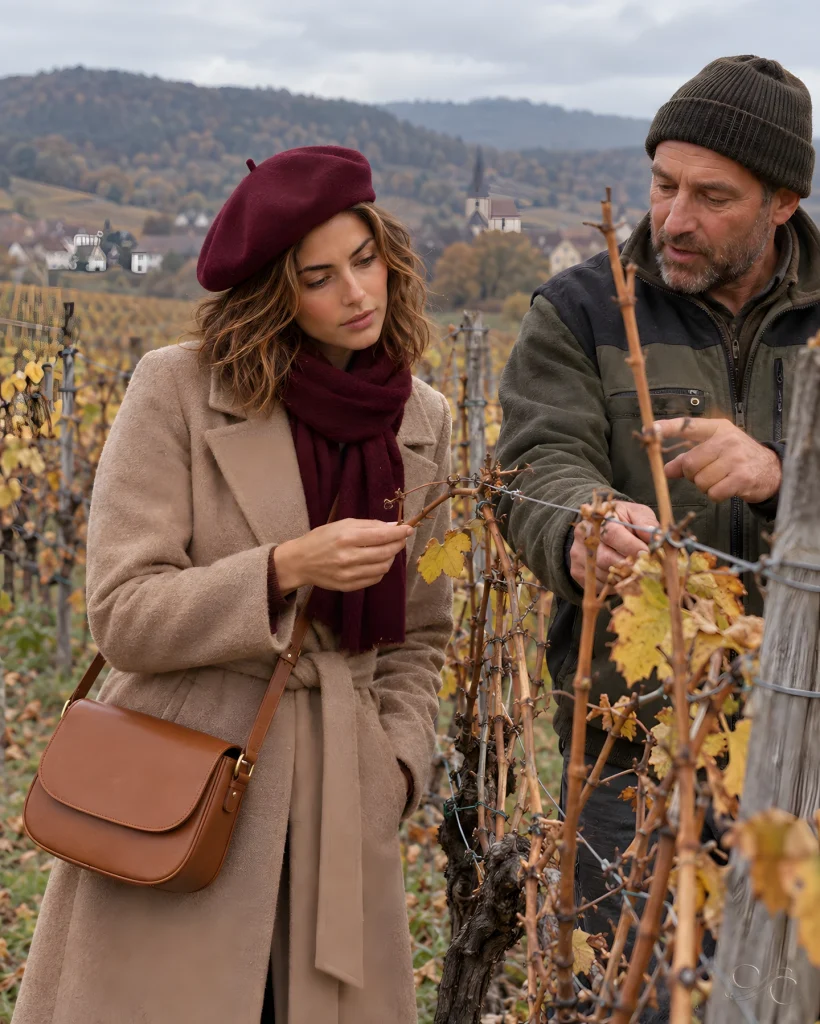
Rust-coloured leaves had thinned enough to expose the canes along the final vineyard rows. A worker fastened a loose vine tie, then invited me to test it with a gentle pull.
The tie held the cane against its support but needed checking so that it would neither slip nor cut into the wood. He pointed farther down the row, where more ties required inspection. The principal harvest had finished, while the work of securing and maintaining the vines continued.
Packing the Pastry Safely
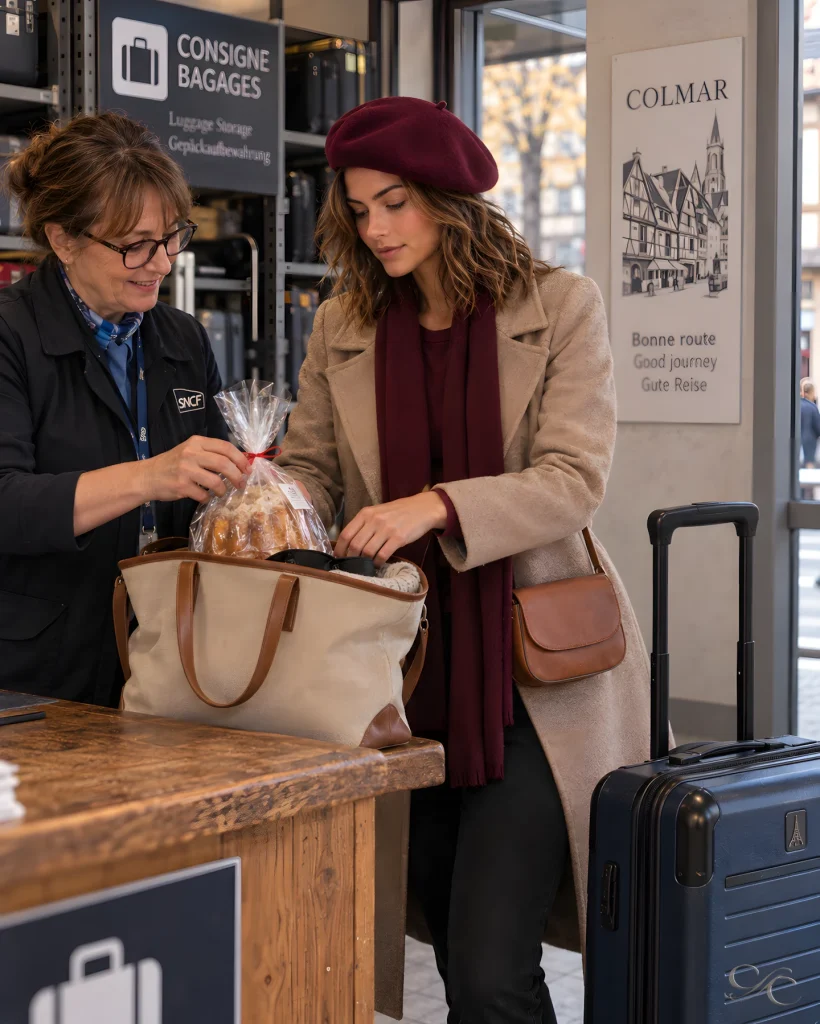
Back from Eguisheim, I collected my stored suitcase and coat before leaving for the station. The wrapped Kougelhopf posed the only difficulty. Its tall crown and ridged sides needed empty space rather than padding alone.
I cleared the top of my travel tote while the attendant lowered the parcel into place, shifting softer items around it. Once the handles closed without pressing against the cake, I was ready to leave.
Homeward Train
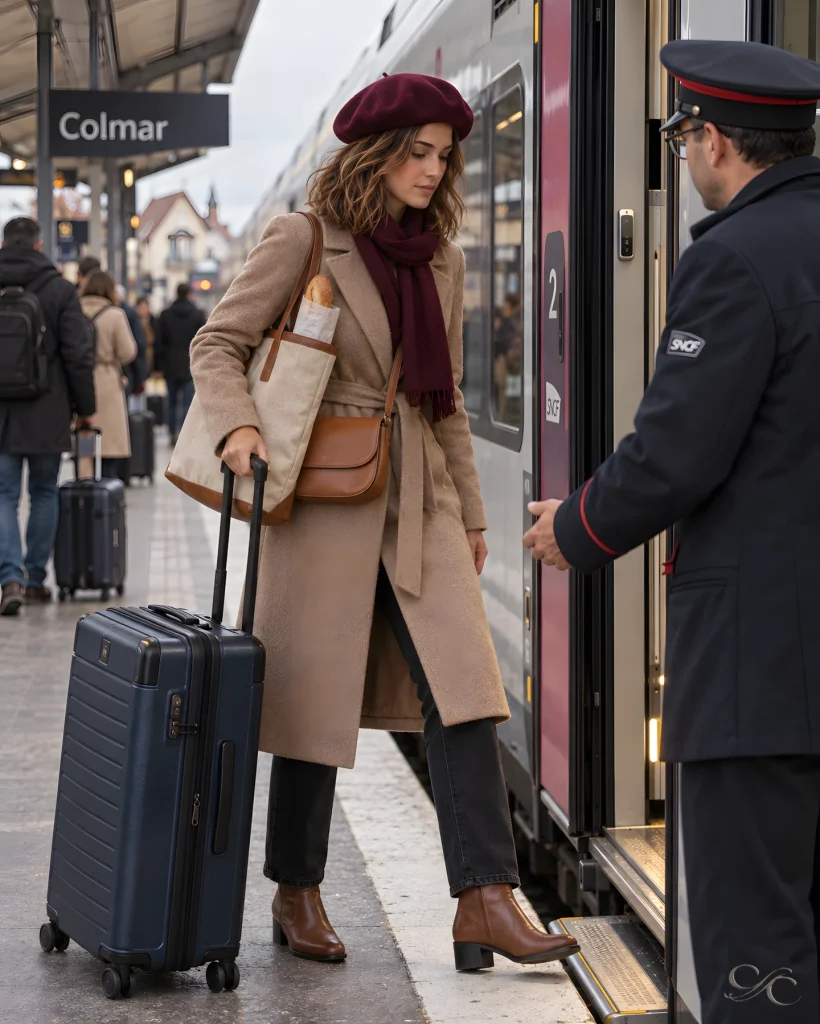
After five days in Alsace, I reached Colmar’s platform beneath an overcast late-afternoon sky. Travellers waited in coats against the cool air.
A railway staff member pointed me toward the carriage entrance as I managed the final step with my suitcase. I kept the bakery-filled tote close to my side. Its contents needed gentler handling than the case.
Wines to Try
Alsace bottles are commonly labelled by grape rather than village or estate blend. Most are white, but sweetness can vary even within the same variety.
- Riesling: Usually dry, with high acidity and citrus or green-apple flavours. Alsace Riesling is often dry and can be relatively full-bodied, though both Alsace and German Riesling cover a wide range of styles.
- Gewurztraminer: Intensely aromatic, with rose, lychee and spice notes. It may contain noticeable residual sugar, so check the label’s sweetness scale or ask before choosing.
- Pinot Gris: Styles range from dry through off-dry to sweet.
- Crémant d’Alsace: Sparkling wine made by the traditional bottle-fermentation method. Pinot Blanc is commonly used, though several other permitted grapes may appear.
- Alsace Grand Cru: A legally protected designation covering 51 named vineyard sites. The vineyard name appears prominently, usually alongside Riesling, Gewurztraminer, Pinot Gris or Muscat.
- Vendanges Tardives: Meaning “late harvest,” this regulated term indicates riper grapes with higher natural sugar levels. These concentrated wines are often sweet, though the exact balance varies.
My Notes
Regional trains made Strasbourg, Obernai, Barr and Colmar straightforward stops, but the smaller wine villages required more planning. Ribeauvillé, Riquewihr and Eguisheim had bus connections, though services could be limited in the evenings and on Sundays. I kept the day’s return timetable available rather than relying on frequent departures.
By November, the principal grape harvest had finished. The vineyards were quieter, daylight was short. Some estates and attractions have seasonal or reservation-only hours, so individual opening times and tasting requirements should be checked in advance. Tastings were best arranged in advance, especially at family-run estates. Warm layers and shoes suitable for damp cobbles and vineyard paths were more useful than a tightly packed itinerary.
Alsace wines were often labelled by grape, but the variety alone did not indicate sweetness. Asking whether a bottle was dry, off-dry or sweet prevented surprises. For the Unterlinden Museum, I allowed more time than expected to see the Isenheim Altarpiece.
I also left space in my luggage. Pottery, cheese and a tall Kougelhopf demanded rather different packing strategies.
The Journey Continues
The Journal Continues
My five days in Alsace ended at Colmar station, but Eguisheim was not the end of the Alsace Wine Route. The road continues south through Rouffach and Guebwiller before reaching Thann, near the southern Vosges. There, the steep volcanic slopes of Rangen form Alsace’s southernmost Grand Cru vineyard.
That remaining stretch will have to wait for another journey, preferably with the same allowance for bakery parcels.
For now, my journey continues south into Switzerland. Basel awaits where France, Germany and Switzerland meet, a city shaped by the Rhine, centuries of commerce and a remarkable artistic heritage. From there, I will travel to Lucerne, where the landscape changes from river valleys and vineyards to lakes and Alpine mountains.
New surroundings, different traditions, and undoubtedly a few more unexpected encounters along the way.
If you’re planning a trip to Germany, Austria, Prague, or other European destinations, 💬 chat with me for ideas on timing, wine, where to stay, and how to shape the journey naturally.
À bientôt, Camille ✨